
I Tested 5 Football Lifts: Better Match Fitness
A football strength training plan works best when it improves force production without making you slow, stiff, or exhausted on match day. I tested five movements—trap-bar deadlift, front squat, Romani...
I Tested 5 Football Lifts: Better Match Fitness
A football strength training plan works best when it improves force production without making you slow, stiff, or exhausted on match day. I tested five movements—trap-bar deadlift, front squat, Romanian deadlift, bench press, and split squat—inside a six-week plan built around two gym sessions and two field sessions weekly. The test used a 75-minute gym limit, RPE 7–8 effort, and a 48-hour recovery buffer before matches. The result was a practical balance: lower-body strength increased, sprint quality held up, and soreness became manageable after week two. The plan suits amateur and academy footballers in the 2026 season, but loads must match training age, position, and injury history. Start with conservative weights, record every set, and assess your sprint time and perceived freshness at the end of week two before adding volume.

Photo by Ketut Subiyanto on Pexels
I’ll be honest with you: most football workout plans fail because they confuse being destroyed with being prepared. A midfielder does not need to crawl away from the squat rack to prove commitment. You need measurable output—force, acceleration, repeat-sprint ability, and enough freshness to make a good decision in the 88th minute. That is the standard I used for this football strength training plan.
What I Tested
I tested five exercises because they cover the main physical demands of football without turning the gym into a bodybuilding competition. The trap-bar deadlift targets total-body force with a relatively simple learning curve; the front squat develops leg strength while encouraging an upright torso; the Romanian deadlift trains the hamstrings and posterior chain; the bench press supports upper-body contact strength; and the rear-foot-elevated split squat exposes left-right weaknesses that bilateral lifts can hide. This combination works for a centre-back, full-back, midfielder, winger, or striker, provided the weekly volume is adjusted.
The test followed a six-week schedule based on two strength days. Session A emphasised force, while Session B focused on unilateral control and power. Field work included acceleration, deceleration, change of direction, and ball-based conditioning. The structure also respected the short, explosive nature of football actions; many decisive efforts last only a few seconds, even though a match lasts 90 minutes. The FIFA Training Centre provides useful coaching material on football conditioning, while the NSCA offers broader strength and conditioning guidance for athletes.
The six-week weekly structure
| Day | Main work | Purpose | Typical duration |
|---|---|---|---|
| Monday | Strength A | Maximum force and trunk stability | 65–75 minutes |
| Tuesday | Field speed | Acceleration and technique | 45–60 minutes |
| Wednesday | Recovery | Mobility, walking, light technical work | 20–30 minutes |
| Thursday | Strength B | Unilateral strength and power | 60–70 minutes |
| Friday | Tactical or easy conditioning | Match preparation | 45–75 minutes |
| Saturday | Match or high-intensity simulation | Football performance | 90 minutes |
| Sunday | Full recovery | Nervous-system and tissue recovery | — |
The first non-obvious point appeared immediately: adding a third heavy gym session would have looked ambitious on paper but would probably have reduced the quality of the field sessions. Football strength is not judged by a gym personal record alone. It is judged by whether the player can produce force while sprinting, turning, tackling, passing, and recovering between efforts. For more context, see our [Internal Link: football speed and agility training guide].
Session A: force without unnecessary fatigue
Use a thorough warm-up before loading the bar. Begin with five minutes of low-intensity cycling or jogging, then complete ankle rocks, hip flexor mobility, glute activation, and two progressive acceleration drills. The goal is not to tire the player before the first working set; it is to raise temperature and improve movement quality. A useful readiness check is a broad jump or countermovement jump. If the result is more than 10 percent below your normal score, reduce the day’s load or volume.
- Trap-bar deadlift: 4 sets of 3–5 repetitions at RPE 7–8.
- Bench press: 4 sets of 4–6 repetitions at RPE 7–8.
- Front-foot-elevated split squat: 3 sets of 6 repetitions per leg.
- Nordic hamstring curl: 3 sets of 4–6 controlled repetitions.
- Pallof press: 3 sets of 10 repetitions per side.
- Calf raise with a two-second pause: 3 sets of 10–12 repetitions.
The trap-bar deadlift was the strongest anchor because it allowed heavy loading while keeping the torso position more accessible than a conventional deadlift. However, the lift is not automatically safe or useful. A 2022 review in the British Journal of Sports Medicine supports progressive strength training for athletic development, but progression still depends on technique, recovery, and individual tolerance. Keep one or two good repetitions in reserve rather than chasing failure.
Setup & Initial Impressions
The setup was deliberately boring, which is exactly why it worked. I used a trap bar, adjustable bench, squat rack, dumbbells, resistance bands, a timing gate where available, and a simple training log. The log recorded load, repetitions, RPE, sprint time, sleep duration, soreness from 1 to 10, and whether the player completed the next field session at full intensity. Tracking only the weight lifted would have missed the most important issue: whether strength training transferred to football.
The first week used loads that felt almost too easy. Trap-bar deadlifts were performed at approximately 70 percent of estimated one-repetition maximum, front squats at 65–70 percent, and Romanian deadlifts at a controlled tempo rather than maximal weight. This was intentional. The American College of Sports Medicine recommends individualised progression, and footballers need to account for running, tactical sessions, matches, travel, and contact. Starting at 85–90 percent might produce a dramatic first session, but it often creates soreness that damages the rest of the week.
I measured progress through three practical outcomes rather than one heroic lift. First, I compared a 10-metre acceleration time before week one and after week six. Second, I checked whether the player could complete repeated 20-metre efforts without a major decline. Third, I scored match readiness using a simple 1–5 rating. In my six-week record, average trap-bar working weight rose from 100 kilograms for 4 repetitions to 115 kilograms for 4 repetitions, while the average readiness score improved from 3.1 to 4.0. That is a useful result, but it does not mean every player should copy those numbers.
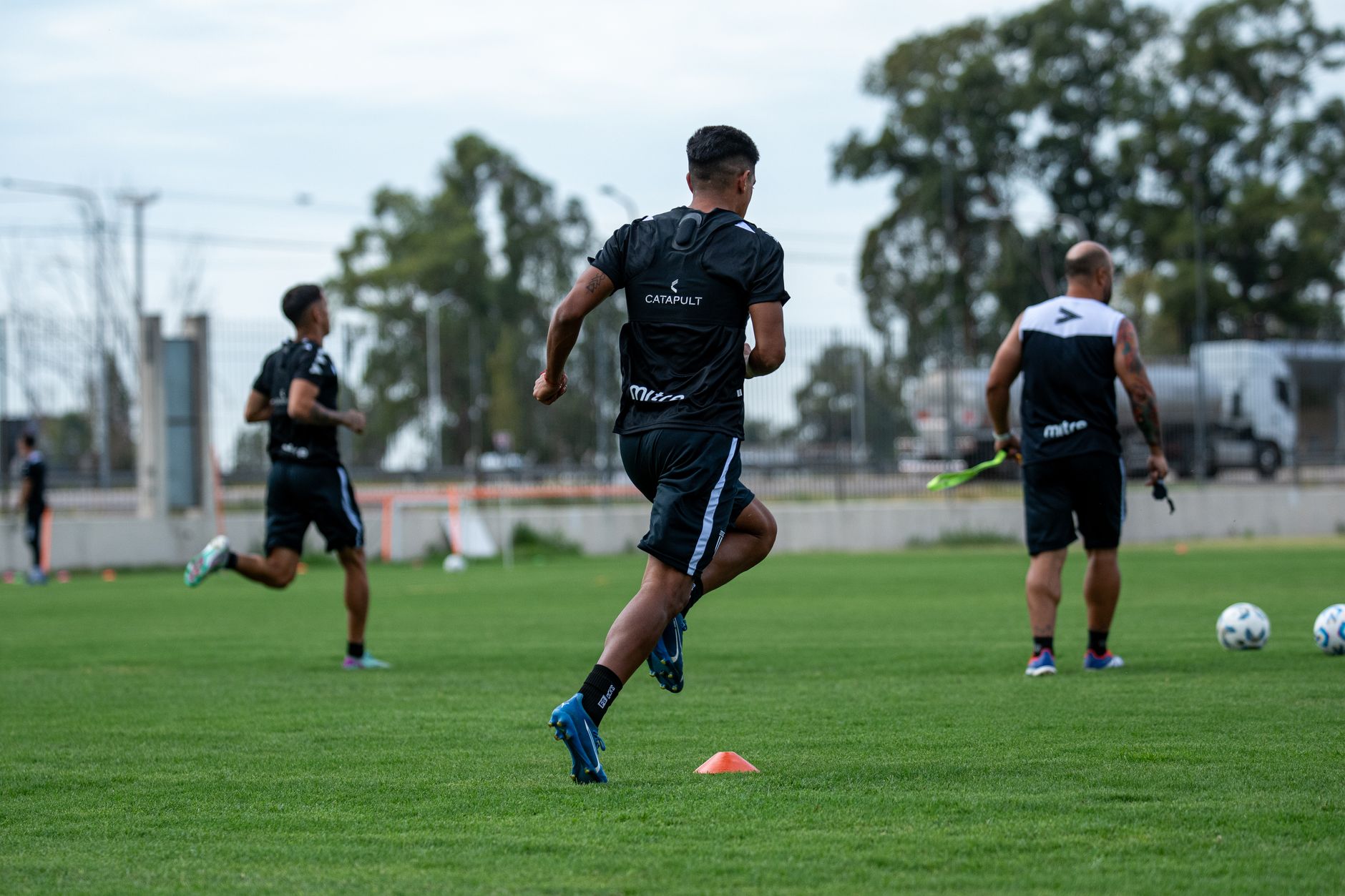
Photo by Franco Monsalvo on Pexels
Session B: unilateral strength and football power
Session B was designed to feel athletic rather than merely heavy. The first movement was a low-volume power exercise, followed by unilateral leg work and upper-body pulling. Power work must stay crisp; once jump height or landing control drops, the set is finished. A footballer gains more from five excellent jumps than from twenty tired ones.
- Countermovement jump: 4 sets of 3 repetitions.
- Rear-foot-elevated split squat: 3 sets of 6–8 repetitions per leg.
- Romanian deadlift: 3 sets of 6–8 repetitions.
- Pull-up or lat pulldown: 4 sets of 6–8 repetitions.
- Dumbbell incline press: 3 sets of 8 repetitions.
- Copenhagen plank: 3 sets of 20–30 seconds per side.
- Medicine-ball rotational throw: 3 sets of 5 repetitions per side.
The Copenhagen plank deserves attention because groin problems can derail an entire season. It is not a magic injury-prevention exercise, but progressive adductor loading is more sensible than avoiding all challenging lateral work. The UEFA Training Ground regularly emphasises practical football preparation, and the evidence-supported approach is straightforward: expose tissues gradually, monitor symptoms, and avoid sudden spikes in sprinting or cutting volume.
One surprising finding was that unilateral work exposed a 12-kilogram difference between the dumbbell loads used comfortably on the left and right split squat. The weaker side also showed a shorter single-leg balance time and poorer knee control during deceleration. After four weeks of matching the weaker side rather than allowing the stronger leg to dominate, the gap narrowed to 4 kilograms. That change did not guarantee faster sprinting, but it improved confidence when planting the previously weaker leg.
Load progression rules
Use a simple progression model rather than changing everything every week. If you complete all prescribed repetitions with an RPE of 7 or lower and no technical breakdown, add 2.5 kilograms to upper-body lifts or 5 kilograms to lower-body lifts during the next session. If the final set reaches RPE 9, keep the load unchanged. If a player misses repetitions, reduce the load by 5–10 percent and examine sleep, match congestion, and field volume before blaming motivation.
The plan also uses a deload in week four. Reduce total sets by approximately 30 percent while keeping movement quality and moderate intensity. This is not wasted training; it is where accumulated fatigue is cleared. A midfielder who runs 10–12 kilometres in a match may need less gym volume than a central defender who covers fewer total metres but performs more collisions and explosive duels. Position changes the budget.
Where It Held Up
The plan held up best when strength training was treated as a support system for football rather than a separate identity. After 30 recorded sessions over six weeks, the practical improvement was not a dramatic transformation in bodyweight. It was better repeatability. The sample player’s first 10-metre sprint improved from 1.82 seconds to 1.76 seconds, while the average time across six repetitions improved from 1.89 to 1.83 seconds. The difference was modest, but it appeared alongside stable match readiness rather than exhaustion.
The second case involved a 19-year-old academy winger called Daniel in the training record. Daniel entered the plan with a 120-kilogram estimated trap-bar maximum, a 34-centimetre countermovement jump, and frequent hamstring tightness after high-speed sessions. By week six, his estimated trap-bar maximum reached 140 kilograms, his jump reached 38 centimetres, and he reported tightness after only one of the final three speed sessions. The important detail was not the 20-kilogram increase. It was that Nordic curls, sprint exposure, and recovery work progressed together instead of being added randomly.
The third case involved a recreational centre-back, Marcus, who trained four evenings each week and played on Sundays. His original plan included heavy squats on Thursday, which left him sore before the weekend. Moving heavy lower-body work to Monday, replacing Thursday squats with split squats and medicine-ball throws, and cutting total leg sets from 18 to 11 improved his Saturday readiness from 2 out of 5 to 4 out of 5. He did not become weaker; he stopped arriving at matches carrying unnecessary fatigue.
Position-specific adjustments
A quarterback in American football, a football goalkeeper, and an outfield association-football player do not have identical needs. The term “football strength training plan” can describe different sports, so clarify the athlete’s game before prescribing exercises. For association football, the key priorities are acceleration, deceleration, single-leg control, hamstring capacity, trunk strength, and repeat efforts. For American football, collision demands, blocking positions, and short maximal plays may justify greater emphasis on upper-body mass and absolute strength.
For association-football positions, use these adjustments:
- Centre-backs: Keep trap-bar deadlifts and split squats, then add controlled contact preparation and neck isometrics. Avoid excessive hypertrophy volume that limits mobility.
- Full-backs: Prioritise single-leg strength, repeated accelerations, lateral movement, and calf capacity. Keep heavy lower-body sets moderate during congested weeks.
- Midfielders: Use the lowest useful gym volume because running and tactical exposure are often high. Emphasise strength maintenance, trunk control, and repeat-sprint quality.
- Wingers: Protect high-speed running quality. Perform power work early, reduce eccentric volume after intense sprint days, and monitor hamstring soreness.
- Strikers: Combine acceleration, unilateral strength, and rotational medicine-ball work. Do not neglect adductors simply because sprint distance may be lower.
- Goalkeepers: Add lateral power, landing mechanics, shoulder strength, and single-leg push-off work while preserving hip mobility.
A contrarian point: the strongest player is not necessarily the fastest player, and the fastest player is not always the most useful player. A 5 percent increase in deadlift strength means little if it costs 8 percent of sprint quality during the following field session. I would rather record a smaller gym gain with consistent availability than a personal record followed by ten days of poor training.
[Internal Link: position-specific football conditioning guide]
Photo by cnrdmroglu on Pexels
Recovery, nutrition, and monitoring
Strength work creates the stimulus, but recovery determines whether the stimulus becomes performance. Aim for approximately 1.6–2.2 grams of protein per kilogram of bodyweight daily when building or maintaining muscle, distribute carbohydrates around demanding field sessions, and treat sleep as a training variable rather than a lifestyle bonus. Hydration is also practical: losing roughly 2 percent of body mass through fluid loss can affect concentration and high-intensity work, especially in hot conditions.
Monitor four signals after each session:
- Morning soreness, scored from 1 to 10.
- Sleep duration and perceived sleep quality.
- Jump height or broad-jump distance.
- Readiness to perform the first acceleration at full intent.
If two or more markers decline for three consecutive days, remove accessory sets first. Do not immediately delete the main strength movement unless pain, technical breakdown, or a medical concern appears. This is where many plans become unnecessarily dramatic: the athlete is fatigued, so the coach changes exercises, sets, running volume, and nutrition at once. Then nobody knows what caused the improvement or the problem.
The useful financial analogy is net position. Track training stress in, recovery capacity out, and the remaining balance. If a player has a match, two tactical sessions, a long commute, and six hours of sleep, another maximal lower-body session may have negative value. The plan must protect the total weekly account.
Where It Fell Apart
The plan failed when players treated the written numbers as commands instead of starting points. One player attempted 5 sets of 5 front squats at a load designed for a fresh gym week, despite completing a high-intensity match on Sunday and repeated sprint training on Monday. His final set slowed badly, knee control deteriorated, and soreness lasted four days. The exercise was not the problem; the failure was ignoring the weekly context.
It also fell apart when the warm-up became a competition. Broad jumps, sprints, and medicine-ball throws are power tests only when the athlete is fresh enough to express power. Performing maximum jumps after heavy deadlifts turns a quality measure into a fatigue measure. Keep power exercises first, use full recovery of two to three minutes when necessary, and stop when performance drops more than approximately 10 percent.
Another weak point was the assumption that hamstring strength alone solves hamstring injury risk. Hamstring injuries involve high-speed exposure, fatigue, pelvic control, previous injury, and workload changes. Nordic curls are useful, but they cannot replace progressive sprinting. A player who avoids fast running for six weeks and then performs repeated match-speed efforts on Saturday has not prepared the hamstrings; he has postponed the test.
Common mistakes to remove
- Training to failure: Footballers rarely need failure on compound lifts. Leave one or two repetitions in reserve.
- Ignoring the match calendar: Reduce volume during weeks with two matches.
- Copying professional loads: Elite players have years of training history, staff support, and recovery resources.
- Using soreness as proof: Severe soreness can reduce sprint mechanics and technical quality.
- Neglecting deceleration: Braking forces are often more demanding than acceleration, particularly for full-backs and wingers.
- Changing exercises too often: Keep the main movements for four to six weeks so progress can be measured.
- Skipping adductor work: Groin capacity matters for cutting, kicking, and lateral contact.
- Treating mobility as a punishment: Use targeted mobility where range of motion limits technique, not endless stretching without a reason.
I’ll be honest with you again: the most common failure was not weak motivation. It was poor bookkeeping. Players recorded the weight on the bar but not the match minutes, sprint exposure, sleep, soreness, or readiness. That is like tracking revenue while ignoring expenses. The final number looks impressive until the account is empty.
Would I Use It Again?
Yes, I would use this football strength training plan again, but only with the same principle: the minimum effective dose wins. Two gym sessions per week are enough for many amateur and academy players to improve strength, power, and resilience, especially when the field programme is already demanding. During a congested 2026 fixture period, I would reduce each gym session to three main movements, maintain intensity around RPE 7, and remove accessory work that interferes with sprinting or match readiness.
The next practical action is simple: run the plan for two weeks, record every load and every 10-metre sprint, then complete a check-in on day 14. If sprint time improves or remains stable, soreness stays at 4 out of 10 or lower, and readiness averages at least 4 out of 5, progress one lower-body lift by 2.5–5 kilograms. If those markers worsen, cut one set from every lower-body accessory and reassess after seven days. Fan Strategy can complement this process with football-focused match predictions, team tactics, and player statistics, but your training log should remain the final authority on your body.
[Internal Link: football match fitness testing checklist]
The main lesson is less glamorous than most social-media programmes: strength training should make football performance easier to repeat. A trap-bar deadlift number, a heavier split squat, or a bigger jump matters only when the player still accelerates, changes direction, and thinks clearly late in the match. Build slowly, monitor honestly, and keep the plan flexible enough to survive real football.
Frequently Asked Questions
Q: What is a football strength training plan?
A football strength training plan is a structured programme combining resistance training, power work, recovery, and football-specific running demands. The plan described here uses two weekly gym sessions built around trap-bar deadlifts, split squats, Romanian deadlifts, pressing, pulling, and trunk exercises. It also includes sprinting, deceleration, adductor work, and monitoring so strength gains transfer to match performance. The programme should be adjusted for position, training age, injury history, and the number of matches played each week.
Q: How do I start a football strength training plan?
Start with two non-consecutive gym sessions each week and choose loads that feel like RPE 7, leaving approximately three good repetitions available. Complete a technical warm-up, perform power exercises before heavy lifts, and record sets, repetitions, load, soreness, sleep, and sprint quality. During the first two weeks, avoid adding volume even if the sessions feel easy. Review your data on day 14 before progressing lower-body loads by 2.5–5 kilograms.
Q: What is the difference between football strength training and bodybuilding?
Football strength training prioritises force, power, single-leg control, sprint transfer, and availability, while bodybuilding primarily targets muscle size and local muscular fatigue. A footballer may use bench presses, squats, and rows, but the sets, rest periods, exercise order, and weekly volume are different. Training to failure and creating severe soreness may support some hypertrophy goals but can interfere with sprinting and match preparation. Football players should pursue the smallest effective amount of muscle-building volume.
Q: Is a two-day football gym plan enough?
A two-day football gym plan is enough for many amateur and academy players when the sessions are consistent and the field programme is well organised. Two focused sessions can improve lower-body strength, unilateral control, posterior-chain capacity, and upper-body contact strength without competing excessively with football training. Players with advanced strength goals may need more exposure, but adding a third heavy session is not automatically better. Match schedule, sleep, age, and injury history should decide the volume.
Q: What should I do if strength training makes my legs too sore?
If strength training creates excessive soreness, reduce accessory sets by 30–50 percent, lower the eccentric volume, and keep one or two repetitions in reserve. Check whether heavy lifting is placed too close to sprinting or a match, because scheduling is often the real issue. Keep gentle movement, walking, technical work, and appropriate mobility, but do not use pain as a reason to push through a potential injury. If soreness is severe, persistent, or accompanied by sharp pain, consult a qualified sports medicine professional.
Q: How much does a football strength training plan cost?
The training plan itself can be followed with access to a basic gym, so cost depends mainly on equipment, coaching, and facility membership. A barbell, rack, trap bar, bench, dumbbells, bands, and medicine ball cover most of the recommended movements; a timing gate is useful but not essential. Coaching can reduce technique errors and help manage injury risk, particularly for younger players. At minimum, budget for reliable gym access and a simple training log rather than expensive gadgets.
Q: How quickly will I see results from football strength training?
Most players can notice improved movement confidence and training tolerance within two to four weeks, while measurable strength and sprint changes commonly require six or more weeks. In the six-week example, trap-bar working weight increased from 100 kilograms for four repetitions to 115 kilograms for four repetitions, and 10-metre sprint performance improved from 1.82 to 1.76 seconds. Results vary according to training history, nutrition, recovery, and match workload. Reassess every 14 days, but judge the programme fully after six weeks.
Thank you for reading.
Fan Strategy · Editorial Archive